
KEMRI Strengthens Ebola Preparedness in Frontline Counties Through Strategic Donation of Protective Supplies
June 9, 2026
KEMRI Management Staff Participate in East Africa Regional Conference on Public Administration and Regional Integration
June 18, 2026KEMRI delegation returns from China with Lessons for Strengthening Kenya’s Public Health Architecture
By Timothy Muasya
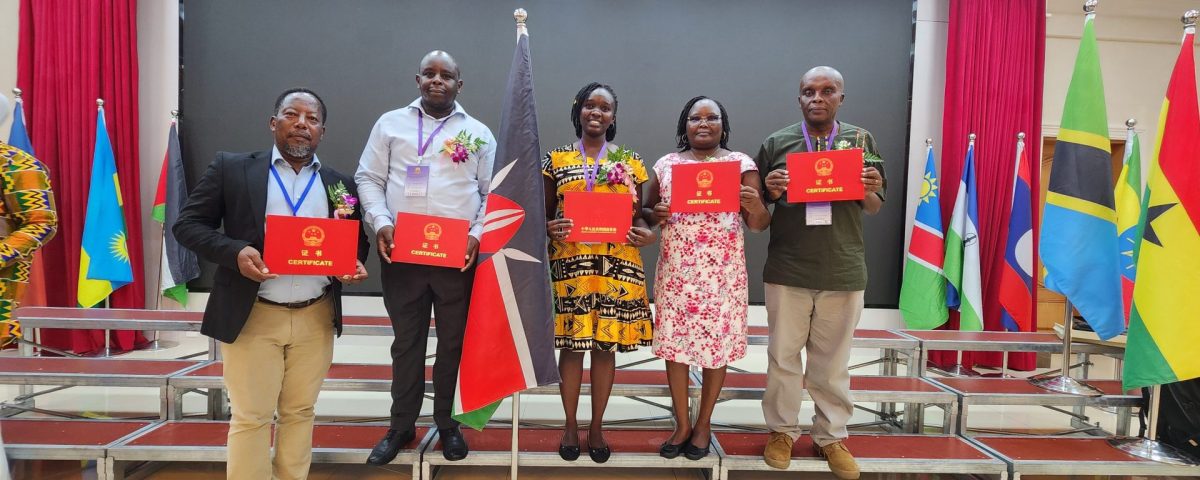
A delegation of KEMRI scientists has returned from Guangzhou, China, with a rich set of lessons on disease surveillance, laboratory biosafety, immunization systems, traditional medicine, and health workforce development insights that could reshape how Kenya designs and delivers its public health response.
The four-member team comprising of research scientists; Timothy Muasya, Nancy Lagat, Valerie Kimutai, and Paul Muchai participated in the Seminar on CDC Construction and Public Health Management for African Countries, held in Guangzhou, Guangdong Province, from 20th May to 2nd June 2026. The programme combined technical sessions with visits to research and industrial parks, museums, and cultural sites, providing a panoramic view of China’s public health infrastructure.
China’s health system is anchored by the National Health Commission (NHC), which oversees the China CDC and sets policies and regulations that provincial, municipal, and county health commissions implement. Each tier has clearly defined responsibilities, enabling coordinated and rapid response.
The delegation noted parallels with Kenya’s own structure the State Department for Public Health and Professional Standards (hosting the Kenya National Public Health Institute) and the State Department for Medical Services, under which KEMRI operates. However, the report flags a key weakness: coordination between national and county levels in Kenya remains uneven. Clarifying roles and strengthening collaboration across these tiers, the delegation observed, would significantly enhance Kenya’s preparedness and ability to respond to public health threats.
Guangdong Province home to 126 million people, 30 per cent of whom are migrants has invested heavily in advanced molecular diagnostics, mobile Biosafety Level 3 (BSL-3) laboratories, integrated One Health surveillance, and well-trained emergency teams. Weekly and monthly reporting structures ensure accountability and continuous monitoring.
Kenya’s outbreak response, by contrast, remains slowed by over-reliance on central, national-level facilities. The delegation recommended devolving rapid-response diagnostic and surveillance capacity to the county level, leveraging mobile diagnostic units and decentralized training. KEMRI, the report suggests, can lead investigations into the effectiveness of mobile laboratories drawing lessons from the CHAMPS study and simulation based emergency training to position itself as the technical backbone of Kenya’s rapid response system.
China’s Smart Vaccination Service System accessible via mobile applications including WeChat has maintained vaccination coverage above 90 per cent for over two decades. The majority of vaccines are domestically produced, keeping costs down and logistics manageable. China has also supplied vaccines at lower prices than those available on the global market, including to Indonesia.
Kenya faces challenges with fragmented immunization records and dependence on imported vaccines. As Kenya prepares to transition out of GAVI support, the delegation recommended that the government explore sourcing more affordable vaccines from China and other partner countries. KEMRI and Kenya Biovax, it noted, can strengthen local research and development efforts to build homegrown vaccine, therapeutic, and diagnostic capacity and get ahead of the curve by developing digital immunization-tracking platforms.
Malaria: China’s journey from high malaria burden to elimination unfolded across five staged strategies from a baseline survey in the 1950s through comprehensive control, monitoring, consolidation, and finally the celebrated ‘1-3-7’ rule: cases reported within one day, investigated within three days, and a focused response completed within seven days. Since 2020, the post-elimination phase has centred on fever checks at ports of entry, proactive seasonal preparation, and intensified mosquito control. With malaria still endemic in Kenya’s western counties, the delegation recommended adopting a structured framework inspired by though not identical to China’s phased model to accelerate elimination efforts
HIV/AIDS and HPV: China maintains a low HIV prevalence. Guangdong Province, with a population of 126 million, records only 40,000 infected individuals primarily among older adults. Health promotion emphasizes voluntary testing, selftesting, confidential digital reporting, and ARV treatment adherence. On HPV, locally produced vaccines cost approximately USD 4, and wide coverage has reduced mother-to-child transmission by 90 per cent. The delegation recommended that Kenya leverage digital communication systems to enhance the confidentiality of results and appointment bookings, which could improve health-seeking behavior and reduce the stigma that remains a barrier to uptake.
COVID-19: China’s COVID-19 response included strict lockdowns, rapid hospital construction, PCR machines supplied to all hospitals, and genomic sequencing capacity deployed to all city-level CDCs. Negative-pressure wards with unidirectional airflow systems were established to contain transmission. Health education was prioritized to sustain public trust in vaccines despite breakthrough infections. For Kenya, the delegation recommended expanding national sequencing capacity, equipping county referral hospitals with PCR diagnostic capabilities, and strengthening public communication during outbreaks. KEMRI, it proposed, should lead health education campaigns to build public trust and advance health science communication.
Schistosomiasis: China is targeting schistosomiasis elimination by 2030. Coastal provinces have already achieved this, but the disease remains endemic in some central provinces due to farming practices near major rivers. Mechanisation — the use of machinery rather than cattle in farming communities — has proven effective in reducing human exposure to themparasite. Kenya can draw from this experience to inform rural health and agricultural policy.
Antimicrobial Resistance (AMR): China has prioritised the fight against AMR through highlevel pathogen-detection capability in hospitals, enabling targeted rather than broad-spectrum antibiotic prescribing. New policies limiting antibiotic use have helped curb resistance. The delegation recommended that Kenya strengthen fast and specific diagnostic networks to promote targeted treatment and reduce reliance on broadspectrum therapeutics — a long-standing challenge in the country’s health system.
Delegates visited the Traditional Chinese Medicine (TCM) Museum at Beijing University of Chinese Medicine and a research and development facility in Zhuhai City, where herbal formulations are developed into both internal and external preparations. China’s TCM system encompasses specialised hospitals, integrative care models, and a thriving R&D ecosystem.
The delegation saw a direct parallel for KEMRI. The Institute’s Centre for Traditional Medicine and Drug Research is strong in research but has yet to move into product development and commercialisation. The report recommended advancing traditional medicine into validated healthcare solutions — developing herbal formulations into standardised products, conducting clinical validation trials, and integrating traditional medicine into mainstream healthcare delivery.
China’s biosafety framework is anchored in risk assessment, control, and management, following the WS 2017 biosafety standard. All laboratory settings operate at a minimum of BSL-2. The delegation noted that Kenya’s biosafety standards remain uneven across counties, with limited high-risk pathogen laboratories.
KEMRI, the report recommends, should spearhead efforts to standardise biosafety protocols nationwide, while government investment in expanded BSL-3 capacity would ensure readiness for high-risk pathogens — a need underscored by the ongoing Ebola Alert situation.
China has supported the Africa CDC headquarters, regional centres, and outbreak responses in countries including Sierra Leone and the DRC. The delegation identified a strategic opportunity for KEMRI to position itself as a key partner in South–South collaborations, leveraging existing bilateral agreements to provide technical support, conduct joint research, and build academic capacity across the region.
The seminar reinforced a core message: Kenya does not need to replicate China’s model wholesale, but can adapt its lessons to its own context and constraints.
For Kenya, the priorities identified by the delegation are stronger inter-tier coordination, decentralised laboratories, smart immunisation tracking, expanded workforce training, structured disease elimination frameworks, integration of traditional medicine, standardised biosafety, and active participation in global health cooperation.
For KEMRI, the opportunity is to move decisively from research to impact — bridging science with policy, commercialisation, and integrative healthcare. This positions the Institute not only as Kenya’s leading research institution, but as a regional leader in public health innovation and resilience.
While China is the second-largest economy in the world and resources may be more readily available for implementation, a key lesson the Kenyan delegation learnt is that accountability and the responsible use of resources are essential to strengthening a nation’s standing and advancement.