Cholera Consortium Workshop Highlights KEMRI’s Capacity for Health Response
April 23, 2026
PS Muthoni Inspect a Site for the Construction of the Proposed Teaching and Research Hospital at KEMRI Kirinyaga
May 7, 2026BUILDING THE FUTURE: KEMRI’s Benchmarking Visit to the Republic of Korea
By Martin Bundi, PhD and Barnabas Kimatoi
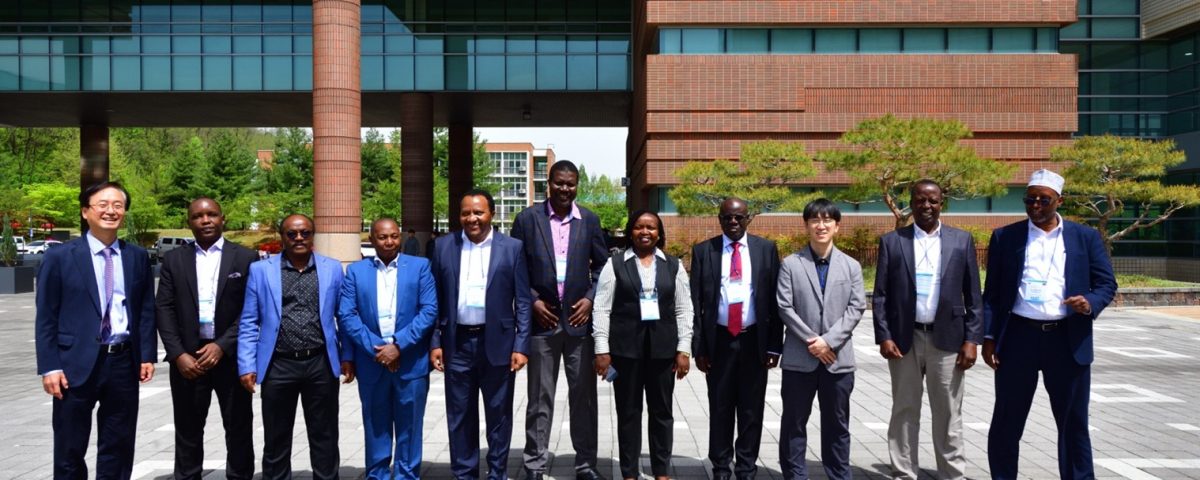
Delegation photograph — Republic of Korea, April 2026 |
In April 2026, a high-level Kenyan delegation led by Dr. Abdullahi Ibrahim Ali, Chairperson of the KEMRI Board of Management, undertook a strategically significant benchmarking visit in the Republic of Korea. The delegation engaged with some of the world’s most advanced research institutions, forging partnerships and gathering insights that will shape KEMRI’s journey into its next chapter as a Specialized Degree-Awarding Research Institution.
The visit was not merely a fact-finding mission, but a declaration of intent — that KEMRI is ready to stand alongside the world’s leading research institutions and that Kenya is serious about building a science and technology ecosystem that delivers tangible health benefits for its people.
| “This visit marks a defining moment for KEMRI. We did not come here merely to observe — we came to learn, to build relationships, and to bring back a practical roadmap for KEMRI’s transformation. What we have seen in Korea is proof that bold institutional investment in science and technology is not a cost — it is the single most powerful driver of national prosperity.” — Dr. Abdullahi Ibrahim Ali, Chairperson, KEMRI Board of Management and Delegation Leader |
Why South Korea? The Purpose Behind the Visit
South Korea is one of the world’s most compelling examples of what is possible when a country deliberately invests in science, technology, and research. In 1971, when the Korea Advanced Institute of Science and Technology (KAIST) was founded, Korea’s per capita income was just USD 290. By 1996 — just 25 years later — it had risen 40-fold to USD 12,197. That transformation was powered, in no small part, by a bold decision to build a world-class, specialized research institution from the ground up.
KEMRI’s leadership recognized that Korea’s story holds important lessons for Kenya. With KEMRI on the cusp of receiving its Charter as a Specialized Degree-Awarding Research Institution — and with a historic USD 1 billion Korea–Kenya Economic Development Cooperation Fund (EDCF) agreement in place — the timing could not have been more opportune. The delegation set out with clear objectives: to benchmark world-class models of research-led specialized institutions, to identify concrete partnership opportunities, and to return with a blueprint that KEMRI can adapt for the Kenyan context.
| “By year 2000, KAIST will be a great institute of technology that will have become the model for a number of analogous institutions in other lands.” — Terman Report, 1970 — the founding vision for KAIST, cited during the delegation’s visit |
A Whole-of-Government Delegation
The delegation was constituted to reflect the national significance of KEMRI’s transition. It brought together not just KEMRI leadership, but also Parliamentary oversight, the Commission for University Education (CUE), the Office of the President, Kenya BioVax Institute, and the Embassy of Kenya in Seoul — signalling that this visit was a government-wide commitment.
| Name | Title / Position | Institution |
| Dr. Abdullahi Ibrahim Ali | Chairperson, KEMRI Board and Delegation Leader | KEMRI |
| Amb. Prof. Emmy Jerono Kipsoi | Ambassador of Kenya to the Republic of Korea | Embassy of Kenya in Seoul |
| Prof. Elijah Martim Songok | Acting Director General / CEO | KEMRI |
| Hon. Julius Kipbiwot Melly | MP, Chairperson, Education Committee | National Assembly of Kenya |
| Hon. Julius Lekakeny Ole Sunkuli | MP, Health and Delegated Legislation Committees | National Assembly of Kenya |
| Ms. Veska J. Kangogo | Advisor, Strategy Execution | Office of the President |
| Prof. John Mike M. Kuria | Commission Secretary / CEO | Commission for University Education (CUE) |
| Dr. Wesley Ronoh | Chief Executive Officer | Kenya BioVax Institute |
| Prof. Joseph Musyoki | Head of Accreditation | CUE |
| Mr. Gathirwa Isaac Wamute | Head of Legal Services | CUE |
| Dr. Martin Bundi | Ag. Director, Research Capacity Building | KEMRI |
| Mr. Barnabas K. Kimatoi | Personal Assistant to the Director General | KEMRI |
The Kenyan delegation — representing KEMRI, Parliament, CUE, the Office of the President, Kenya BioVax, and the Embassy of Kenya in Seoul
Institutions and Venues visited
The delegation visited five major institutions across Daejeon and Seoul, with individual site visits spanning classrooms, laboratories, clinical facilities, innovation hubs, and diplomatic premises. Together, these engagements provided a comprehensive view of how South Korea has built an integrated ecosystem of research, training, healthcare, and industry.
| Institution | Key Focus Areas | Date |
| KAIST — Main Campus, GSMSE Munji Campus, KARA Data and Research Hub, Startup KAIST | Governance model, research-training integration, commercialization, entrepreneurship | 20–21 April |
| Embassy of the Republic of Kenya in Seoul | Diplomatic briefing, partnership facilitation, KOICA funding pathways | 22 April |
| National Cancer Center (NCC) — Research Institute, Hospital, Cancer Registry, Proton Therapy Centre | Integrated research-hospital-training model, cancer data systems, translational oncology | 22 April |
| Myongji Hospital and Catholic University Hospital | Smart hospital systems, clinical infrastructure, ODA training programmes | 23 April |
| PCL Inc. — Multiplex Diagnostics and Smart Blood Banking | Diagnostics technology transfer, blood safety infrastructure | 23 April |
| International Vaccine Institute (IVI) — SNU Research Park | Vaccine R&D pipeline, capacity building, Kenya BioVax collaboration, technology transfer | 24 April |
Highlights from the Visit
Learning from the KAIST Model
The first two days at KAIST were, for many in the delegation, the most profound. Received by Vice President Prof. So Young Kim, the delegation was welcomed into an institution that today ranks among the world’s top 55 universities and whose graduates account for nearly a quarter of Samsung’s entire research and development workforce.
Emeritus Professor O Ok Park delivered a seminar that drew a direct parallel between KAIST’s founding context in 1971 — a Korea with a brain-drain problem, a per capita income of USD 290, and a bold government decision to invest in specialized science — and Kenya’s position today. ‘Future is not for prediction,’ he told the delegation, ‘but for planning.’ The room understood immediately: what Korea did in 1971 is what Kenya has the opportunity to do now.
KAIST Main Campus, Daejeon — 20 April 2026
The delegation also visited the Graduate School of Medical Science and Engineering (GSMSE) at KAIST’s new Munji Campus — a state-of-the-art facility featuring open-lab clusters designed for interdisciplinary biomedical research, shared core facilities, and a 14,000-cage animal research facility under construction. GSMSE’s model of training physician-scientists and medical scientists alongside active, funded research is precisely the vision KEMRI holds for its own postgraduate programmes.
Perhaps most practically inspiring was the visit to Startup KAIST, where the delegation saw how KAIST has institutionalized the journey from laboratory bench to commercial product. Through dedicated intellectual property policies, incubation spaces, and entrepreneurship training, KAIST has spun off companies now operating at the frontier of cancer genomics and RNA therapeutics. The message was clear: the translation of research into real-world impact requires deliberate systems — not luck.
| “What KAIST has demonstrated over fifty years is that the bold decision to invest in a specialized institution pays extraordinary dividends — not just for the institution, but for the entire nation. Kenya now has the same opportunity. KEMRI’s Charter is our version of that founding decision, and we must meet this moment with the same seriousness of purpose that Korea did in 1971.” — Prof. Elijah Songok, EBS, Ag. Director General/ CEO, KEMRI |
| | ||
KAIST Graduate School of Medical Science and Engineering (GSMSE) and Startup KAIST — 21 April 2026
A Warm Welcome at the Embassy
On the morning of 22 April, the delegation paid a courtesy call on H.E. Ambassador Prof. Emmy Jerono Kipsoi at the Embassy of Kenya in Seoul. The Ambassador gave an energizing briefing on the depth of the Kenya–Korea bilateral relationship — 18 active national Memoranda of Understanding, two Presidential visits in recent years, and a Korea that she noted mirrors Kenya in population size and parliamentary structure while offering a blueprint of what focused investment in science and technology can achieve. The Embassy’s role in facilitating the entire benchmarking mission — including identifying KOICA as a potential funding partner — was warmly acknowledged by Dr. Ali on behalf of the delegation.
Cancer Research: A Model for Integrated Science
The afternoon of 22 April took the delegation to the National Cancer Center (NCC) in Goyang-si — an institution that exemplifies what is possible when a country integrates a research hospital, a graduate school, a national cancer control mandate, and a data infrastructure under one institutional roof. The NCC’s results were striking: from 100,000 new cancer cases per year in 1999 to nearly 300,000 today, yet with the world’s lowest cancer mortality-to-incidence ratio and a national survival rate of 73 per cent. That achievement rests on a national screening programme with close to 80 per cent compliance — free under Korea’s national health insurance system.
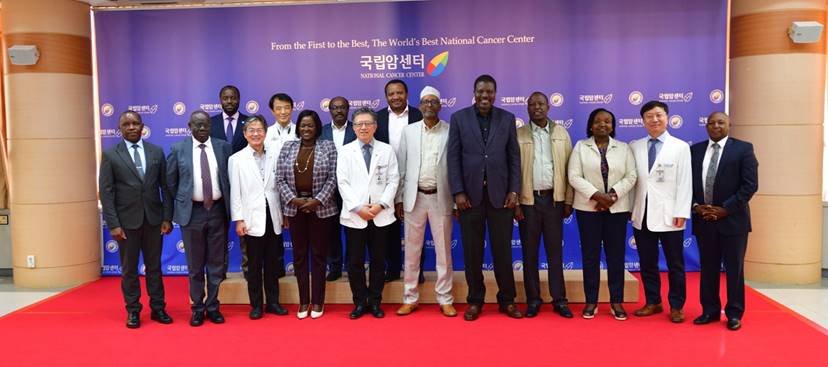
National Cancer Center, Goyang-si — 22 April 2026
Diagnostics, Blood Safety, and Smart Hospitals
Day four brought the delegation to Myongji Hospital — a 680-bed, IHF Award-winning private hospital that has trained over 180 international healthcare professionals from 80 countries. The hospital’s diagnostic automation suite, specialized organ transplant centre, and integrated digital health information system offered the delegation a vision of what a modern, patient-first clinical infrastructure looks like in practice.
The meeting with PCL Inc. was one of the visit’s most immediately actionable engagements. PCL has developed a multiplex immunodiagnostics platform capable of detecting over 60 viruses from a single sample at one-tenth of conventional cost — and has successfully transferred this technology to Morocco, where a local diagnostics manufacturing facility now produces kits at commercial scale. PCL presented a compelling proposal to replicate this model at KEMRI: a Smart Diagnostics Factory beginning with malaria, syphilis, and dengue kits, with the capacity to scale to 29 diseases.
| Myongji Hospital — Smart Hospital Systems Tour | PCL Inc. — Multiplex Diagnostics Technology Briefing |
Myongji Hospital and PCL Inc. — 23 April 2026
Vaccine Science: Building Kenya’s Sovereign Capacity
The final day of the visit took the delegation to the International Vaccine Institute (IVI) at the SNU Research Park in Seoul — a treaty-based international organization dedicated to developing and delivering affordable vaccines for poverty-associated infectious diseases. IVI has over 50 active projects across 23 African countries, with Kenya as a State Party and KEMRI as an active research partner. Kenya BioVax Institute presented its plans for end-to-end vaccine manufacturing at Konza Technopolis, and IVI confirmed that the feasibility study supporting this project is nearing completion.
| “A vaccine factory without the workforce to staff it will fall short of its transformative potential. Korea’s lesson is that manufacturing is only one node in a complex, interdependent system.”— Prof. Elijah Songok, EBS, Ag. Director General/ CEO, KEMRI |
International Vaccine Institute (IVI), SNU Research Park, Seoul — 24 April 2026
What This Means for KEMRI: Key Benefits
The Korea benchmarking visit was not an end in itself. Its value lies in the concrete benefits it has generated for KEMRI and the broader Kenyan research and innovation ecosystem. The following are the most significant outcomes of the visit:
| Benefit | Detail |
| A Blueprint for Specialized Institutional Design | KAIST’s founding story and governance choices provide KEMRI with a tested template for how to design a specialized research institution that operates outside the conventional university model yet achieves world-class outcomes. The key lesson: governance structure is not a bureaucratic detail — it is a strategic instrument. |
| A Postgraduate Training Model That Works | GSMSE’s physician-scientist and medical-scientist dual-track model, embedded within active research laboratories and supported by shared core facilities, provides a directly adaptable model for KEMRI’s postgraduate programmes. The visit confirmed that KEMRI’s existing infrastructure and research portfolio already positions it well to launch an ambitious training programme. |
| Institutional Partnerships Now in Formation | The visit catalyzed formal partnership discussions with KAIST, the National Cancer Center, IVI, and PCL Inc. — covering student and faculty exchange, joint research supervision, translational oncology, diagnostics manufacturing, and vaccine capacity building. These are actionable partnership frameworks, not expressions of goodwill. |
| A Diagnostics Manufacturing Opportunity Ready to Implement | PCL Inc.’s offer to transfer its multiplex diagnostics manufacturing technology to KEMRI — using the Morocco model as a proven, zero-risk blueprint — is one of the most immediately actionable outcomes of the visit. Beginning with malaria, syphilis, and dengue, and scaling to 29 diseases, this initiative would establish KEMRI as a diagnostics production hub for the region. |
| Vaccine Manufacturing Ecosystem Strengthened | The visit strengthened KEMRI’s role as the workforce development anchor for Kenya’s vaccine manufacturing ambitions. The alignment between KEMRI’s charter transition, Kenya BioVax’s manufacturing plans, and IVI’s capacity building programmes creates a coherent, mutually reinforcing ecosystem — with KEMRI at its centre. |
| Diplomatic and Funding Pathways Opened | The Embassy briefing identified KOICA as a key funding partner for several proposed collaborations. KAIST colleagues also pointed the delegation toward the Korea EDCF framework as a mechanism for financing ecosystem investments. These funding pathways are now actively being pursued. |
The delegation also extends its sincere gratitude to H.E. Ambassador Prof. Emmy Jerono Kipsoi and the staff of the Embassy of Kenya in Seoul, whose initiative in organizing and facilitating this visit made every engagement possible. The Embassy’s role as Kenya’s bridge to Korea’s science and innovation ecosystem is invaluable — and this visit has shown what that bridge can deliver.
What Comes Next
The delegation returned to Kenya with momentum and a clear set of priorities. In the weeks following the visit, KEMRI is moving on several fronts: initiating tripatite Memorandum of Understanding discussions with KAIST and the National Cancer Center and institutions in Kenya with already established partnerships with Korean institutions; establishing a working group with PCL Inc. to develop a feasibility study for the Smart Diagnostics Factory; supporting the completion of the IVI–KOICA feasibility study for the Konza vaccine facility; and engaging the Embassy of Kenya in Seoul to activate KOICA funding pathways for priority collaborations.
Above all, one message resonated across every institution the delegation visited: a formally chartered KEMRI will be a far stronger and more credible partner on the global stage. The Commission for University Education has completed its accreditation review, and the grant of Presidential assent to the KEMRI Charter stands as the single most consequential near-term milestone for the Institute. When that moment arrives, KEMRI will not be stepping into the unknown. It will be stepping forward — armed with partnerships already in formation, models already benchmarked, and the confidence that comes from having seen, first-hand, what bold institutional investment in science can achieve.
| “We leave the Republic of Korea with concrete partnerships in formation, a diagnostics manufacturing blueprint that is ready to implement, a strengthened vaccine science collaboration, and a renewed conviction that KEMRI’s best years are ahead of us. The Charter is the key that unlocks all of this — and the KEMRI Board is fully committed to ensuring we are ready to rise to that moment.” — Dr. Abdullahi Ibrahim Ali, Chairperson, KEMRI Board of Management |
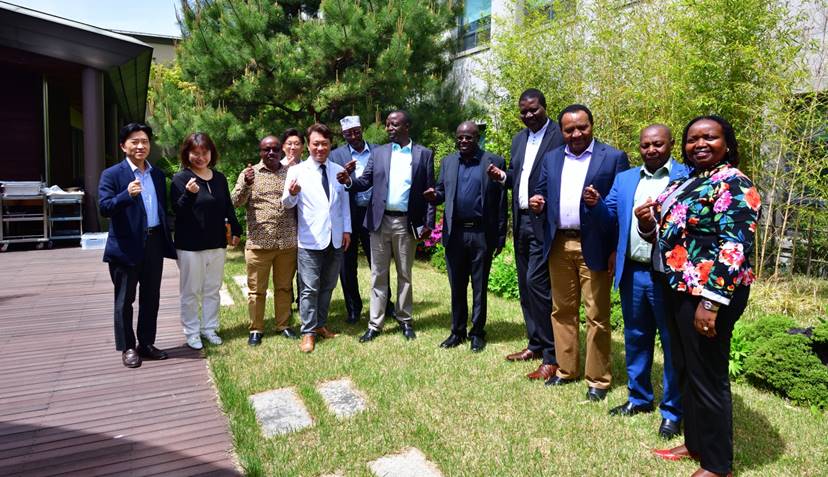
Delegation closing photographs — Republic of Korea, April 2026
| “This benchmarking visit has given us not just inspiration, but a concrete foundation. Korea’s story — from a country investing in its first science institution fifty years ago to one of the world’s great innovation economies — is Kenya’s story waiting to be written.” — Dr. Abdullahi Ibrahim Ali, Chairperson, KEMRI Board of Management and Delegation Leader |
Kenya Medical Research Institute (KEMRI) | Internal Bulletin | Special Feature | April 2026