
Inaugural Women’s Health Ecosystem Forum seeks to advance African-led research and innovation
November 5, 2026
KEMRI Selected as Partner in New German-Kenyan Centre of Excellence on Artificial Intelligence
November 5, 2026Kenya’s Digital Superhighway and What It Means for Your Next Research Project
Exploring the link between digital connectivity, pathogen genomics, and disease surveillance
By Lavin Asami and Dr. Mwangi Joseph
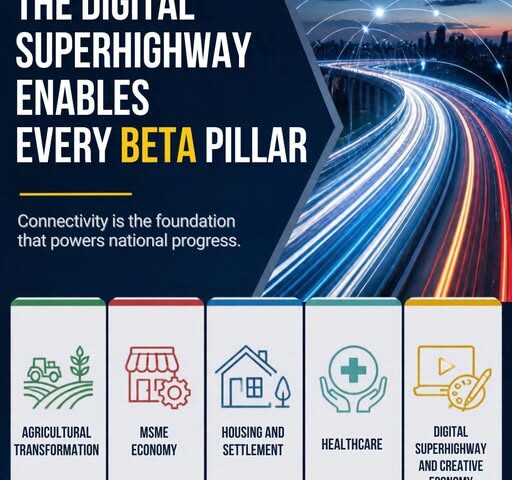
When most researchers hear about Kenya’s 100,000 km Digital Superhighway expansion, one would likely see it as an IT project meant exclusively for e-citizen services and public Wi-Fi.
However, figure out this: Collecting samples is only the beginning of disease research. Once those samples reach the laboratory, researchers still have to generate data, analyze results, compare findings, and make sense of what they reveal. When data are difficult to access or computing resources are limited, even promising research can take longer than expected.
The government’s ambitious target of expanding fibre-optic infrastructure to 100,000 kilometers is often associated with internet access, public Wi-Fi, and digital government services. Nevertheless, there is another side worth exploring: what could better connectivity mean for researchers studying infectious diseases? For those working in pathogen genomics and disease surveillance, it could open up new ways to share data, collaborate across institutions, and turn scientific findings into information that public health teams can use.
When the data are there, but the connections are missing: Consider a team studying a viral borne disease. Researchers collect samples from different counties, sequence the pathogens in a laboratory, and begin analyzing their genetic characteristics. To understand what the results mean, they may also need metadata-information about where the samples were collected, the patterns of disease transmission, and relevant clinical findings. The challenge is bringing all this information together. Data may sit in different institutional systems, while large genomic files require substantial storage and computing power. Field teams may also face delays sharing updates with laboratory researchers. These challenges can make it harder to see the bigger picture, even when the individual teams are doing valuable work. Kenya’s Digital Superhighway, part of the Kenya National Digital Master Plan 2022–2032, enabled by the Digital Health Act (2023) and Data Protection Act (2019) provide solutions to address some of these barriers by expanding the connectivity needed to move information between locations and institutions.
Better Connectivity Transform Your Research Pipeline in several ways
Strengthen Grant Applications with Local Infrastructure:
Grant reviewers are e increasingly demanding clear evidence of cost-efficiency, data sustainability, and local capacity. By explicitly embedding national high-speed research networks and integrated digital surveillance systems into your methodology, you demonstrate that your project leverages robust local infrastructure.
Accelerate Field to Lab Pipelines:
If your studies involve field collection, such as tracking vector movements, monitoring antimicrobial resistance patterns, or sampling remote cohorts, outdated data pipelines will slow you down. The superhighway ultimately will enables protocols where field metadata streams instantly to central analytical dashboards, collapsing weeks of logistical delays into real-time operational astuteness.
Bringing genomic and surveillance data together:
A pathogen’s genetic sequence can tell researchers a great deal about its characteristics and evolution. However, when genomic findings are considered alongside relevant epidemiological and geographical information, researchers may be able to answer broader questions about how infections spread and change over time. For example, teams investigating drug resistance could benefit from being able to compare findings across locations and institutions more efficiently. Researchers monitoring emerging pathogens could also gain a clearer understanding of patterns that might otherwise remain hidden in separate datasets. Connectivity make collaboration easier while providing the necessary systems to achieve this. It is important to remember that Health information must still be handled in accordance with ethical requirements and privacy protections, including Kenya’s Digital Health Act, 2023, and Data Protection Act, 2019.
Making large-scale genomic analysis more practical:
Generating sequencing data is one thing; analyzing it is another. Work involving next-generation sequencing (NGS), metagenomics, and phylogenetic analysis require significant computing power. Research teams without suitable local resources may have to rely on external facilities or find workarounds that slow down their analysis. Reliable high-speed connectivity, alongside access to high-performance computing and cloud resources, help researchers process large datasets and work more easily with collaborators elsewhere. This is particularly relevant for Kenyan and other African research institutions seeking to strengthen local research capacity. Better access to computing resources could help more teams undertake complex analyses closer to where their research questions reside. Notwithstanding, connectivity alone cannot replace the need for appropriate equipment, funding, software, and skilled personnel. It however, facilitate researchers make better use of these resources.
Getting research findings to public health teams sooner
Traditional research findings often sit in a journal for months before policymakers notice it. Research that plugs into national digital standards is far easier for public health agencies to adopt. Your work transforms from an isolated journal article into actionable intelligence that directly informs national disease response and frontline public health policy. Moving away from small, fragmented sample sizes toward localized, real-time clinical trends allows you to validate epidemiological hypotheses against broader, high-quality demographic data. Reporting research findings, especially during an outbreak or disease pattern begins to emerge matter most. Imagine field researchers identifying a potential change in a pathogen while surveillance teams are monitoring reported infections in the same region. If the relevant data is analysed together and shared securely, teams are better placed to investigate what is happening and communicate useful evidence to public health authorities. Connected digital systems support this process by reducing delays in transferring information between field teams, laboratories, and analytical teams. For researchers, this creates an opportunity to think about impact earlier in the research process. Who might use the findings? How will relevant information reach them? And what partnerships are needed to make the evidence useful beyond a published paper?
Technology and policy are only as powerful as the science they enable. By synchronizing our research frameworks with the national digital superhighway, we open the door to unprecedented speed, scale, and public health impact
What can researchers do now?
When planning your next project, think about data management and digital infrastructure as early as you think about laboratory resources and sample collection.
Start by identifying how your data will be stored, transferred, and analysed. If your project involves collecting samples across several counties, consider where delays might occur between fieldwork and laboratory analysis. You may also want to explore partnerships with institutions that have suitable computing facilities or complementary datasets. It is equally important to establish relationships with surveillance teams, healthcare institutions, and policymakers where relevant. Better connectivity can make information easier to share, but collaboration and trust are what help turn that information into meaningful action.
Building a stronger foundation for connected science
Internet infrastructure alone will not automatically connect health records, provide access to research databases, or give every laboratory advanced computing facilities. Those benefits will depend on interoperable and compatible systems, institutional investment, appropriate data-sharing arrangements, and the resources available to researchers. Dedicated high-speed research pipes connected to local High Performance Computing (HPC) nodes eliminate the need to rely on expensive overseas servers or underpowered lab desktop setups to run complex phylogenetic trees, metagenomics assemblies, or spatial models.
Kenya’s Digital Superhighway presents an opportunity to strengthen the connections that modern research increasingly depends on. For infectious disease researchers, those connections could support more efficient genomic analysis, wider collaboration, and closer links between scientific evidence and public health decisions. Realizing this potential will take more than laying fibre-optic cables. Research institutions will need the right digital tools, computing resources, skilled personnel, and secure ways to share information. For those planning future projects, it is worth considering how these developments might shape the way research is conducted in the years ahead. This is why Kenya’s Digital Superhighway deserves the attention of the research community.
Better connectivity will matter most when it helps researchers answer important questions, understand disease patterns more clearly, and provide evidence that improves public health.
The Conversation Continues
Through this series, the Infectious and Parasitic Diseases Research Program (IPDRP) explores the evolving landscape of infectious disease research, from policy and digital innovation to the infrastructure driving scientific progress.
Next month, we turn our attention to other critical areas shaping how research is conducted, strengthened and translated into public health impact.
What are your thoughts? Join the conversation in the comments or connect with the IPDRP Communications Desk.