
KEMRI and Japan Strengthen Ties as Ministry of Finance Official Visits
March 19, 2026
KEMRI Hosts Joint Command and Staff College Delegation to Explore Health and National Security Collaboration
March 19, 2026KEMRI Partners with University of Toronto on Africa Health
BY GIDEON KIRUI
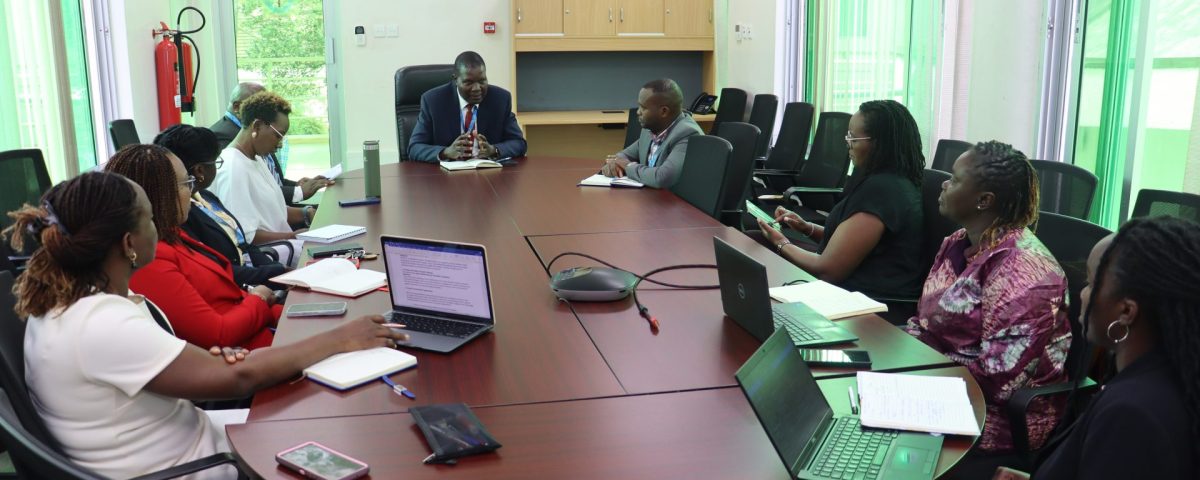
In another strategic move to strengthen health research, KEMRI has expressed strong interest in joining the Africa Health Collaborative (AHC) network, following a consultative engagement with a delegation from the AHC Secretariat at the Institute’s headquarters in Nairobi on 11th March 2026.
The engagement was a follow-up to earlier discussions held in November 2025 in Toronto, Canada and represents a key milestone in KEMRI’s efforts to collaborate with like-minded institutions committed to transforming health systems across Africa.
The delegation comprised senior representatives from Africa Health Collaborative (AHC), including Senior Director for International Relations, Africa, Dr. Peninah Lam, Regional Lead (Health Networks), International Research Officer Dr. Marie Thérèse Ndiaye, and Programme Officer (East Africa), Kenya, Ms. Lillian Bogonko. Their visit marked an important step in deepening discussions on KEMRI’s potential membership in the growing continental initiative.
The Africa Health Collaborative, an initiative led by the University of Toronto (UofT) in partnership with the Mastercard Foundation, brings together nine reputable institutions of higher learning across Africa, including Kenya’s Moi University and Amref Health Africa. Through its Secretariat, the initiative facilitates collaboration among partners by leveraging the University of Toronto’s global network to connect institutions with relevant subjectmatter experts and resources.
Launched in 2021, the initiative emerged in response to lessons learned during the COVID-19 pandemic and the need for African institutions to take a more proactive role in strengthening the continent’s health systems.
In her opening remarks, Dr. Lam reflected on the origins of the collaborative, noting that the pandemic prompted higher education institutions to reassess their role in addressing global health challenges.
“All the partners came together at a time when we, as higher education institutions, really needed to rethink our role and contribution during a pandemic,” she said. “In 2021, when the crisis was affecting the entire world, we agreed that health had to be our collective focus.”
She emphasized that pandemics have far-reaching consequences beyond health alone, affecting economies, education systems, and livelihoods. According to her, institutions of higher learning possess the research capacity, expertise, and innovation needed to help strengthen health systems across Africa.
During the meeting, the KEMRI team highlighted the Institute’s ongoing initiatives in vaccine manufacturing, herbal medicine research, and public health programs. Acting Director General, Prof. Elijah Songok also noted that the Institute is strengthening its capacity in data science, citing a recent Memorandum of Understanding signed with the African Institute for Mathematical Sciences (AIMS), another member of the AHC network.
Prof. Songok said KEMRI’s global partnerships and research reach position the Institute well to contribute meaningfully to the collaborative. He added that engagement with the University of Toronto and other partners would further strengthen KEMRI’s international footprint.
“Government priorities and the growing public demand for better healthcare continue to drive the Institute’s push for stronger partnerships and collaborations,” he observed.
On capacity development, Prof. Songok acknowledged that limited knowledge in intellectual property management remains a challenge for many research institutions. He noted that KEMRI scientists would benefit greatly from capacity-building opportunities possible through the AHC platform, particularly in patenting innovations and protecting intellectual property generated from research.
Prof. Songok also highlighted the importance of strengthening grant management systems, noting that confidence among donors is often influenced by the robustness of financial and administrative processes.
“We believe we can attract more funding if there is greater confidence in our grants management systems. As we strengthen entrepreneurship, data science, genomics, and policy, and support the growth of the KEMRI Graduate School, building strong grants management capacity will also be key to advancing research and improving health systems.” he said.
Dr. Lam reiterated that the collaborative seeks partners committed to long-term engagement and shared values. “We are looking for partners who share the same values as we do and who are interested in longterm collaboration,” she said. “Our goal is to build a direct relationship between the University of Toronto, KEMRI, and the wider AHC network.”
Acting Deputy Director for Resource Development and Knowledge Management, Ms. Lilian Mayieka also highlighted challenges faced in translating research innovations into marketable products. She pointed to the “valley of death” in innovation — a stage where promising research fails to progress into viable products or solutions due to limited investment and commercialization capacity.
Ms. Mayieka stressed the importance of strengthening proof-of-concept processes and enhancing the entrepreneurial skills of research scientists. She added that mentorship programmes could play a key role in equipping researchers with business and innovation management skills.
She further emphasized the need to strengthen KEMRI’s commercialization framework to ensure research outputs successfully reach the market. She noted that such efforts, would enable the Institute to generate revenue from its innovations while contributing to improved healthcare solutions.
Speaking on genomics and precision medicine, Acting Deputy Director for the Biotechnology Programme, Dr. Damaris Matoke-Muhia underscored the importance of developing solutions tailored to the genetic diversity of African populations.
She noted that many medical treatments and diagnostic tools are developed based on ambiguous populations, creating a gap in effective treatment for African communities.
According to Dr. Matoke, partnerships that support infrastructure development and human resource training could significantly strengthen genomics research and precision medicine initiatives in Africa.
University of Toronto’s Dr. Ndiaye noted that the AHC ecosystem is built around the unique strengths and priorities of each partner institution. She explained that the collaborative operates under three guiding pillars: Health Employment, Health Entrepreneurship, and Health Ecosystems. The latter pillar, she said, particularly recognizes the central role of research institutions such as KEMRI in advancing health innovation.
Prof. Songok expressed optimism about KEMRI’s prospects of joining the collaborative, noting that the Institute aligns closely with the initiative’s membership framework.
“What we have discussed resonates strongly with our priorities,” he said. “We are excited about this opportunity and will now move forward towards specific areas where we can collaborate.”
He directed the KEMRI team, together with Dr. James Kuria, who leads the Institute’s resource mobilization efforts, to facilitate the next steps toward formalizing the partnership.
The AHC Secretariat, visibly impressed by KEMRI’s strong research portfolio, encouraged the Institute to intensify its public communication efforts. Enhanced visibility, they noted, would help build public trust, attract potential collaborators, and strengthen the impact of scientific research.
Other KEMRI officials present during the meeting included Ms. Valarie Kimutai from the KEMRI Graduate School representing Acting Director for Research Capacity Building Dr. Martin Bundi, Ms. Annette Miriti from the Commercial Enterprise Department supporting resource mobilization efforts, and Mr. Barnabas Kimatoi from the Office of the Director General.