The Evolution of HIV Care and the Quest for Cure
February 19, 2026KEMRI, WRAIR Discuss Renewal Of Research Partnership Amid Emerging Health Threats
By Gideon Kirui
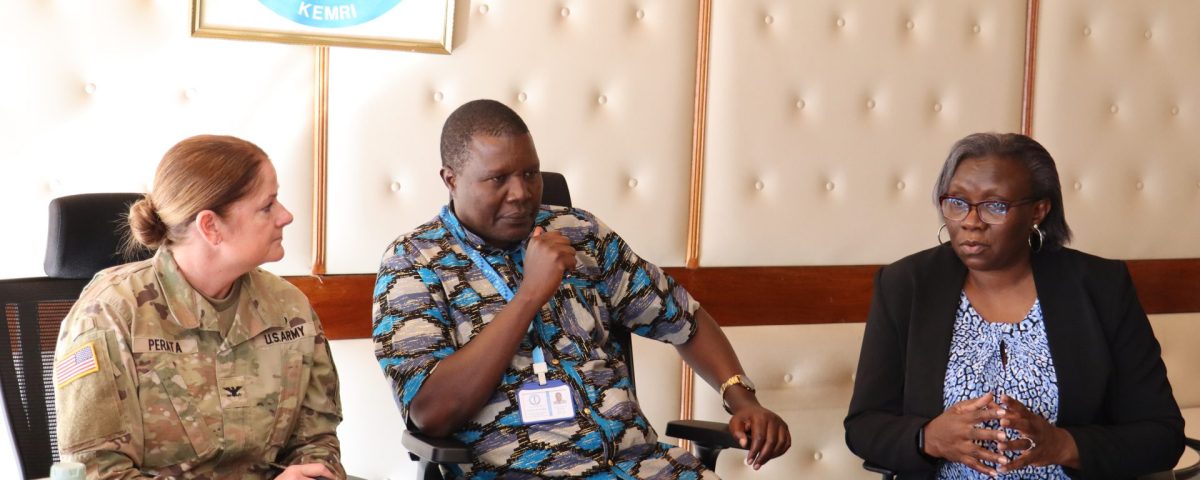
A high-level delegation from the Walter Reed Army Institute of Research (WRAIR) led by Commander Colonel Brianna Perata paid a courtesy call on the Institute’s Acting Director General, Prof. Elijah Songok on 13th February 2026, to discuss the future of the partnership between the two institutions, which is contingent on the pending renewal of the Research Other Transaction Agreement (rOTA).
Col. Perata was accompanied by Command Sergeant Major Monnet Bushner; Chief Science Officer Dr. Karen Peterson; Director of WRAIR–Armed Forces Research Institute of Medical Sciences (WRAIR-AFRIMS) Colonel Matt Levine; and Associate Director of WRAIR’s Experimental Therapeutics Branch, Major Blair Dancy, for a meeting also aimed at strengthening disease surveillance, clinical trials, resource pooling, and capacity building.
Prof. Songok expressed appreciation for WRAIR’s longstanding support, describing the partnership as one of the longest and most successful collaborations. He emphasized KEMRI’s growing strategic role in national biodefense following its recent elevation to an institution of national strategic importance and added that this milestone will further strengthen the relationship.
Providing an update on the rOTA, Director of Corporate Services Mr. Jones Otuke, who has been coordinating the legal instruments of the process alongside the Director of Legal Services and Corporation Secretary Ms. Margaret Rigoro, reaffirmed KEMRI’s desire to renew the partnership formally, following a series of meetings along with various advisories involving the relevant government bodies. He attributed delays in operationalizing the agreement to Government-to-Government (G-to-G) arrangements.
Pending feedback from the Ministries of Finance and Foreign Affairs, Prof. Songok noted that the rOTA is expected to be finalized soon, ideally before April, while the collaboration continues under an extension valid until 30th September 2026. However, the KEMRI team committed to following up on the matter, expressing their eagerness to sustain the partnership spanning more than four decades as they seek to successfully navigate the recently enforced bureaucratic procedures.
WRAIR expressed its readiness to support the expediting of the process and urged KEMRI and the Kenyan government to fast-track it, cautioning that prolonged delays could undermine the future of the partnership and ongoing research.
“We look forward to a continued collaboration, and hope that this agreement moves forward promptly, protecting the strength of our partnership and the important research it supports,” Col. Perata said. Prof. Songok welcomed this support, reiterating that concerted efforts by all parties will ensure timely finalization of the agreement, safeguarding the long-standing collaboration and advancing critical research initiatives.
To address complex procedures more effectively, KEMRI is developing internal legal instruments, as disclosed by the Director General, Prof. Songok. “We are working on our own legal instruments to streamline internal processes, which, if approved, would grant the Institute powers to act without lengthy procedural detours.”
While setting the stage for the discussions, Acting Director for Scientific Programmes, Partnerships, and Grants Management (DSPPGM), Dr. Zipporah Bukania, highlighted key achievements of the partnership, including capacity building and malaria research at Kisumu, a site where WRAIR maintains a strong presence. She underscored the need to expand collaboration beyond HIV and malaria to address emerging health issues, such as drug resistance and surveillance. She also noted the potential for support in tackling Neglected Tropical Diseases (NTDs) and expressed hope that the relationship could evolve from project-based models to structured institutional partnerships, enhancing both efficiency and sustainability. “We hope this discussion will help move us forward. As an institution, we are committed to continuing our collaboration with you and to steadily strengthening our research capacity,” affirmed Dr. Bukania.
Acting Deputy Director, Dr. Eric Ochomo Centre Director of the Centre for Geographical Health Research (CGHR), which now houses Kombewa and Kondele sites, reported that the urban malaria vector Anopheles stephensi is spreading rapidly and has been detected along the coast. Both delegations agreed that the emerging threat of malaria calls for coordinated intervention. WRAIR pledged support, noting that the vector also poses a military concern due to the presence of US forces along the Kenyan coast.
During the discussions, Prof. Songok was also joined by Acting Deputy Director of KEMRI-Kericho, Dr. Fredrick Kirui, and Mr. Barnabas Kimatoi from the Director’s office.