Yes! We Can End TB!
March 25, 2026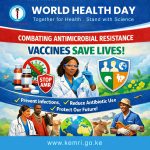
KEMRI’s Spotlight as World Health Day Aligns Timing and Purpose
April 13, 2026Call for More Investment in Research & Development for Kenya’s Health Future

By Gideon Kirui
The country has been encouraged to invest in science and research as its cornerstone of the journey toward Universal Health Coverage (UHC) and health sovereignty. Acting Director General, Prof. Elijah Songok is emphatic that through
investment into Research and Development, Kenya’s human capital is assured.
Speaking during a virtual launch of the World Health Day 2026, Prof. Songok underscored the importance of this year’s theme, ‘Together for Health: Stand with Science’, describing it “as a timely reminder of the critical role research plays in safeguarding public health”.
World Health Day, commemorated annually on 7th Aprilunder the auspices of the World Health Organization
(WHO), marks the organization’s founding and drawsattention to priority global public health issues. This year’s
observance launches a year-long campaign celebrating the power of scientific collaboration to safeguard the
health of people, animals, plants, and the planet.
The DG noted, in a presentation made on his behalf by Acting Director, Research and Development, Dr. Erick
Muok, that for KEMRI, science is not merely theoretical but a practical tool for service, protection, and hope—
bridging the gap between policy decisions and the wellbeing of citizens.
“For over four decades, KEMRI has remained at the forefront of generating evidence that shapes health policy and practice in Kenya and beyond,” he said. “Our mission is to improve human health and quality of life through
research, innovation, and service delivery.”
Others who spoke at the special commemorative session included the WHO Representative, Dr. Neema
Rusibamayila Kimambo and Ministry of Health, Director General, Dr. Patrick Amoth.
Prof. Songok further highlighted the Institute’s key contributions, including generating high-quality data
to inform Ministry of Health policies, conducting disease surveillance and outbreak investigations, and
developing diagnostics, drugs, vaccines, and other health technologies. Prof. Songok added that KEMRI continues
to play a vital role in nurturing the next generation of Kenyan scientists while supporting local manufacturing
and innovation.
The DG emphasized that the institute’s research priorities are closely aligned with Kenya’s universal health coverage
agenda, addressing a wide range of health challenges—from infectious and non-communicable diseases to
climate-sensitive illnesses and emerging pathogens.
Citing tangible impact, Prof. Songok pointed to KEMRI’s contribution to HIV research, where its scientists have
participated in landmark prevention and treatment trials that have informed national guidelines and helped reduce
HIV-related deaths. This work, he said, has positioned Kenya as a global leader in HIV research.
He also referenced the institute’s pivotal role during the COVID-19 pandemic, noting that KEMRI rapidly scaled up nationwide testing, conducted genomic sequencing to track variants, and provided real-time data that guided
government decision-making.
“These successes demonstrate what happens when scientists, policymakers, healthcare workers, and communities work together—a true example of standing with science,” explained Prof. Songok.
Prof. Songok, however, cautioned that the fight to uphold science must go beyond laboratories. He called on researchers and partners to actively combat misinformation, mentor young scientists, and ensure that research remains ethical, inclusive, and responsive to real societal needs.
“Science must speak the language of the people, reach communities, influence policy, and inspire trust,” he said
As Kenya continues to advance towards Universal Health Coverage (UHC), he stressed that strengthening domestic research capacity is no longer optional but essential. He urged stakeholders to prioritise sustainable investment in local research, promote young scientific leadership, enhance collaboration between researchers and policymakers, and ensure that research findings are translated into actionable policies.
He called on government leaders, scientists, health workers, development partners, and communities to uphold their commitment to science—not only during crises but as a continuous national priority.
Given KEMRI’s strong leadership in research, the Institute has been tasked with spearheading the campaign, working
closely with various directorates within the Ministry of Health to promote the work being done by researchers across sectors to improve health. The campaign will highlight both scientific achievements and the multilateral cooperation required to translate evidence into action, with a strong emphasis on the One Health approach—one of KEMRI’s key research programme areas.
While reaffirming KEMRI’s commitment to the cause, Prof. Songok stated: “KEMRI will continue to support the awareness campaign launched today. Together, we will build a Kenya where decisions are guided by evidence, innovations are homegrown, and every Kenyan benefits from the power of research.