
Third CVR Symposium Calls for Research to Translate into Greater Health Impact
October 7, 2026
New Community Advisory Board Strengthens EARN Trial Engagement in Kisii
October 7, 2026KEMRI, US CDC reaffirm commitment to sustained collaboration amid changing health cooperation landscape
BY LISPER MOKAYA
The Institute and the United States Centers for Disease Control and Prevention (CDC) have reaffirmed their commitment to sustaining their longstanding partnership in health research, disease surveillance, laboratory systems and public health capacity building, despite significant changes in the global health cooperation and funding landscape.
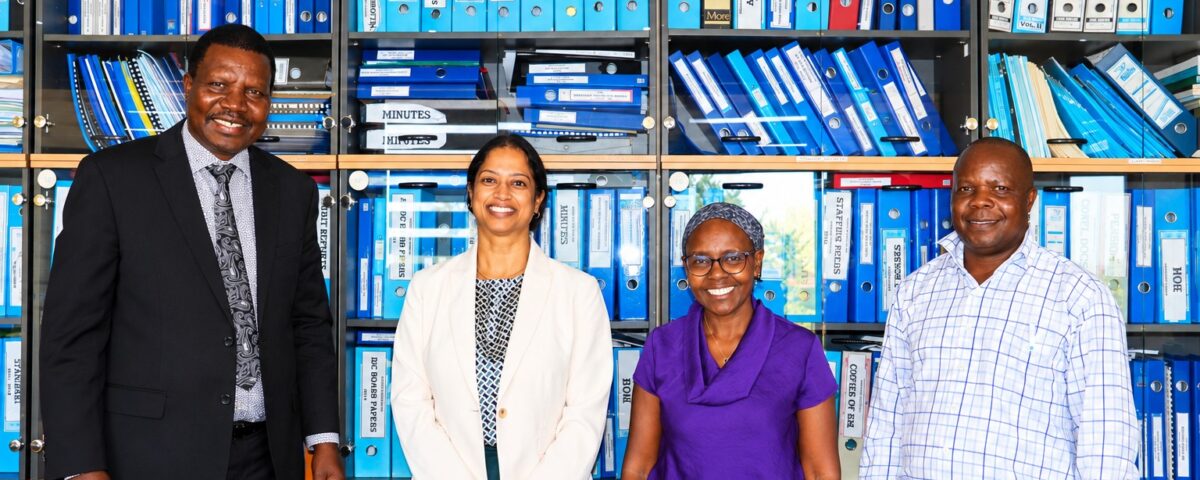
The commitment was reaffirmed during discussions between Vice Chancellor and CEO, KEMRI, Prof. Elijah Songok, and the newly appointed CDC Kenya Country Director, Dr. Runa Gokhale, during her introductory visit to KEMRI.
Dr. Gokhale, who also oversees the Division of Global Health Protection, said the relationship between the two institutions remained important despite changes in the resources available to support their joint programmes.
She noted that the funding model for the CDC had undergone significant changes, with shrinking resources increasingly being channeled through different and non-traditional mechanisms. The evolving environment, she said, would require both institutions to explore innovative and sustainable ways of maintaining their longstanding collaboration.
However, Dr. Gokhale stressed that the changing funding environment should not be interpreted as a weakening of the relationship between the two institutions. “What has not changed is the strength of the relationship and the importance of the relationship between CDC and KEMRI, and our determination to figure out how to make that work,” she said.
The KEMRI-CDC partnership dates back several decades and has played a significant role in strengthening Kenya’s public health research and response systems. Dr. Gokhale noted that KEMRI was among CDC’s earliest partners in Kenya, with the collaboration initially focusing on malaria research in Western Kenya region before expanding into other areas of public health.
A significant part of the discussions focused on changes in the health cooperation framework and their implications for programmes and institutions that have traditionally benefited from US-supported initiatives.
Dr. Gokhale explained that while the evolving health cooperation framework would influence the environment in which the two institutions operate, it would not eliminate opportunities for continued collaboration.
She clarified that CDC-supported cooperative agreements would continue to exist both within and outside the health cooperation framework.
Prof. Songok welcomed Dr. Gokhale to KEMRI and highlighted the transformative impact of the KEMRI-CDC partnership, describing it as a cornerstone of public health infrastructure, diagnostic excellence and epidemiological response in Kenya and the wider East African region for more than four decades.
“Our collaboration with CDC Kenya is grounded in a deep, shared history of scientific rigor and mutual commitment to safeguarding public health,” said Prof. Songok. “As we welcome Dr. Runa Gokhale, KEMRI looks forward to elevating this partnership to higher levels, driving innovative, research-led interventions that address both localized health concerns and global health threats.”
Prof. Songok emphasised that KEMRI’s role has increasingly expanded beyond its traditional research mandate to include strengthening capacity across the country’s wider public health system and pointed to the Institute’s established expertise in disease surveillance, laboratory systems, research and training as a strong foundation for supporting capacity development in counties and other institutions.
The vision, he explained, is for KEMRI to serve as a centre of excellence and a source of expertise whose capabilities can be leveraged to strengthen public health capacity beyond the Institute, an approach, welcomed by Dr. Gokhale, describing it “as a vision that CDC would be ready to support. “The vision you’ve laid out is a really strong one, where KEMRI serves as a reference, or as a centre for excellence and a hub for this capacity to then be expanded…devolved elsewhere,” she said.
The discussions also explored opportunities to leverage KEMRI’s extensive research infrastructure and expertise as Kenya strengthens its capacity to detect and respond to emerging and re-emerging health threats.
Dr. Gokhale said the CDC’s evolving role as a national public health institute places increasing emphasis on strengthening capacity for rapid outbreak detection and response.
She observed that many of the platforms, skills and capabilities developed through research could be applied more directly to public health surveillance, preparedness and emergency response.
“A lot of our history has been around research and development. But really, as the national public health institute, we see ourselves more as there to build capacity for faster outbreak detection and response,” she said and added that an important consideration would be how existing research platforms and expertise could be adapted to support faster detection and response to outbreaks.
Prof. Songok also outlined KEMRI’s plans to expand its training and innovation agenda in response to the changing health landscape and highlighted the Institute’s interest in developing specialised postgraduate training programmes in emerging areas such as mathematical modelling and data science, which could strengthen Kenya’s capacity to analyse, interpret and apply health data.
Prof. Songok expressed appreciation for the contribution of the CDC partnership to KEMRI and Kenya’s wider public health system, noting that the collaboration has generated significant scientific, technical and institutional capacity over the years that ought to be insulated from current global health dynamics.
As both institutions navigate the evolving global health cooperation landscape, the discussions underscored a shared commitment to ensuring that investments made over decades continue to strengthen Kenya’s capacity to conduct cutting-edge research, detect health threats early and mount effective responses to public health emergencies. The meeting was also attended by Dr. Naomi Lucchi and Dr. Bonventure Juma from the US CDC Kenya office, and KEMRI’s Ag. Deputy Director, Corporate Communications, James Wodera